Peter Radizeski is Founder and President of RAD-INFO INC. He is an accomplished blogalyst, speaker, author and consultant. He has helped many service providers with sales training, marketing, channel development and business strategy. He is a trusted source of knowledge about the telecom sector. His honest and direct approach make him a refreshing speaker.

Look for his innovative ideas and analysis of current technology on his blogs.

Meet him at one of the many conferences he attends and speaks at.

Hire RAD-INFO today!

Rio Bravo

Seth Godin often gets me thinking. One of his posts this week was spot on. Seth used two westerns as examples.

“Howard Hawks, director of Rio Bravo, pointed out that the reason that the marshal [in High Noon] failed to rally the community was that he was asking. In search of affiliation, he shared his fears and a story of mutual support as well as loyalty for what he’d done for them for so long.”

“In Rio Bravo, on the other hand, John Wayne does nothing of the sort. He regularly turns down offers of help, being selective about who’s worthy of being on his team. He shares no fear or trepidation. He’s selling status and dominance, not affiliation. “Are you good enough to be on this team?””

“Humans are motivated by affiliation or by status.”

Put up the Red Velvet Rope. Create a line to get in. Make it a little harder to join the program.

Put the mirror away. Just because a Partner can fog the mirror doesn’t mean they make a good partner. How Aligned are they? Why are the adding you to the Portfolio? How will you work together?

I understand that there are KPIs in some programs just for recruiting – get the agreements signed – even if that partner doesn’t do anything else. The problem is the time and effort of signing up a partner without Enrollment is a waste of time.

The KPI isn’t the sheer number of Partners — it is the number of selling Partners!

TSB’s flash their partner numbers – 2500, 5000, 8000 – they only send checks to about 20% of that number. (Thank you, Pareto.)




Microsoft Gets Closer

Microsoft had a cell phone and a plan. It went up in smoke. Now it is Android or iOS – Apple or Google. Yet placement on that phone is as important as placement on a laptop home screen.

With the Metaswitch acquisition, Microsoft saw a possible win. Over 700 ILECs use Metaswitch to provide voice. Most of them were not going to move to NFV or SDN on their own. Azure allows that to happen in a simpler fashion.

Microsoft Teams ultimately wants to be the default softphone on mobile devices.

Now with announcements by Verizon Business and Broadvoice, MS is two steps closer.

Verizon reports: “Mobile users will be able to place calls through the Microsoft Teams desktop application, an integrated IP phone or the dialer on the mobile device…. The deeper integration of mobility into Teams has three potential impacts, the company says: It enables easy and quick application of enterprise policies, reduces costs of parallel management of mobile and desktop systems and provides a path to moving all activity to mobile handsets.” [source]

Broadvoice announced, “The Virtual b-hive Seat for Microsoft Teams enables remote users to make and receive calls within the Teams app on their existing mobile devices; no desk phone, softphone, or mobile app is required. The service is made possible through Direct Routing and is enabled natively within Teams.” [source]

Microsoft Teams as the endpoint for all business communications is the end game.

Are You Looking to Sell Your Business?

Lots of M&A in the channel – both vendors and partners. Are you looking to sell your Agency or business? What’s the Goal?

Are you just looking for investment for growth? Do you need help in the back office? Do you need technical expertise? There are ways to fill in those blanks while still retaining control of your business.

Have you had enough? Been doing this a long time and want to retire? Well, for certain hire an attorney. No matter how many phone calls you get or how much pressure, hiring an attorney is always a smart investment.

Know what you want and shop around. This is a seller’s market because there are a lot of buyers.

You are going to need a business to sell and by that I mean a corporate entity, books, CRM and systems in place. These are ingredients to a healthy valuation of a sellable business.

Some things to ask yourself: Will your business run without you? What are your assets? What about liabilities? What does your P&L look like? Do you pay rent or have a long term office lease? Do you have payroll? What expenses are getting in the way of an improved EBITDA?

Culture was mentioned by the Upstack CEO  because individuals in our business have personalities and they don’t all fit well in org chart. But that may be required for 3 to 5 years.

The fine print is the whole point!

Know what the goal is. Shine light on all the details.

No one gives money away without a return. No one.

Remember the Lesson of TNCI! The Agent Equity Plan? It went Poof!

Honestly, when I see all this money entering the channel, I know that it is a bubble ready to explode. These investors have put over $650 million into brokers/agencies (not to mention the billions in MSP M&A and MSP vendor M&A). They want at least $1.3 Billion back at the least.

Yet we are seeing fire sales in the UCaaS provider space – think Fuze and Netfortris. Why? Investors have been in that company much longer than they expected – and they want out. They will take the haircut.

Numerous IPOs and SPACs have been put on hold. Why? Market isn’t friendly.

Remember that your assets are Yourself, your client list, your commissions and any other revenue stream. Those are also the same assets that any broker/master agency has. Some may have intellectual property, but that would have to have commercial value. So mostly the revenue for a TSD is just the commissions they collect for us. Of course, MDF funds are also an income stream for ALL of the formerly known as master agencies. Keep that in mind when negotiating.

Good article on Channel Futures to read about where Partners are and what to think about.

No matter what anyone holding a microphone tells you: the Agent space is not dying. They have been saying it for 10 years and have been wrong so far. Yes, slinging just internet makes it harder to make a living with declining revenues.


The Netfortris Acquisition

I wrote about Sangoma buying Netfortris HERE, but after speaking with Sangoma I wanted to add some color.

Spire Capital bought a chunk of Netfortris, a UCaaS, SD-WAN and MSP combo, in 2014 – about the time Telekenex renamed itself Netfortris. Then, in 2017, Netfortris acquired Fonality, an Asterisk powered UC provider known for its partners and its HUD (heads up display). Now Fonality is under the Asterisk/Digium umbrella with the acquisition by Sangoma.

Sangoma surprised me when they told me the deal has closed already. Sangoma gets 60K UCaaS seats, 6,000 billing customers and $50M in annual revenue for about 1.3x revenue. The deal is for $68M (The upfront cash amount was USD $48.8 million and the upfront equity amount was USD $19.2 million) with a $12M earn out for one year as the Netfortris sales team remains in place – and separate – to maximize the transition.

Sangoma already has a video meeting service, contact center, a CPaaS platform and a few unified communication systems from earlier acquisitions that include VoIP Innovations and Star2Star. Netfortris will bring more than just UCaaS. Sangoma’s portfolio will now include SD-WAN (powered by Fortinet and Velocloud), cyber-security (Threat Management), managed access, managed network and the ability to single bill.  This allows for many opportunities to cross-sell and make customers stickier.

Demand for both managed network and SD-WAN has been robust since the pandemic. Single Bill is something that SMB look for in order to keep things simple. This allows Sangoma to also address the SMB’s flourishing need for security.

Executives at the company were quoted as saying that this might open up the company to to acquire MSP’s in the future to bolster the managed services and security practices.

Sangoma has about 2 million on-premise seats that can be moved to cloud that they offer. This is all part of the overall strategy to upsell and cross-sell to every customer – and meet them where they are in the cloud – whether that is premise of not.


Netfortris will bring with it relationships with 700 partners that do not overlap much over current partners from Star2Star and other acquisitions.

There are more than a few vendors in the UCaaS space looking to exit, according to Jim Machi, EVP of Product Management and Marketing at Sangoma. Likely that means that there will be more deals “that make sense”.

The Size of the UCaaS Market

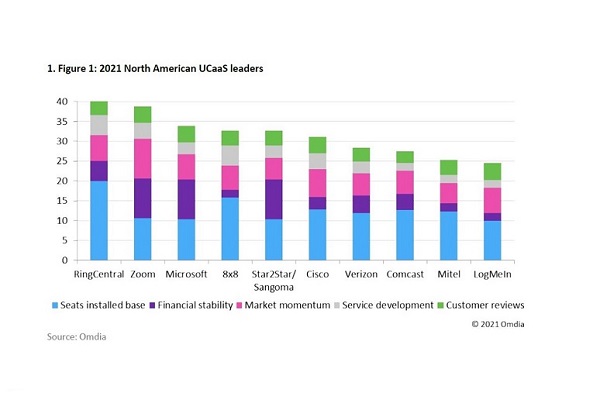
Each analyst has a different idea of the market size of UCaaS globally. The global estimates range from $20 Billion USD in 2021 to $46B USD. That’s a wide range.

Yet the service providers don’t really break out the revenue. CPaaS, CCaaS, UCaaS, Collaboration, Video, SIP Trunking, Direct Routing – where do all these buckets of money fall?

What is a UCaaS seat? Is it a video license from Zoom or just the Zoom phone license?  Are Mitel’s 3M advertised cloud seats considered UCaaS? Well, not any more. RingCentral will be counting any of those cloud seats.

RNG has about 3.5M seats and $1.2B in revenue.

8×8 has 2M seats and $601M but 100K DR4MT clients.

Vonage has $1.25M in revenue but most of that is CPaaS.

Zoom has 2.4M phones and $4 Billion in revenue, much of it in video.

Microsoft has about 5M MS Teams Phones (of the 80M) plus 270M MST licenses. (5M x $10 + $38/mo for 80M E5 licenses + 190M F3 licenses @ $8/mo =  $600M + $36Billion + $18B = $55B for UC&C for MS depending how you classify that.)

The rest of the Top 10 estimate at 5M seats. The 10th spot was 875K seats according to Gartner MQ – and then it starts dropping.

The top 11-20 estimate at 3M seats combined.

The next 1900 providers combined might equal about 10M seats with an average of 5K seats each.

Netsapiens (now owned by CXDO) has a total of 2.5M seats on its platform, which includes all it’s white labelers. CXDO’s total revenue is $28M. Most UC providers never hit the $100M in revenue mark. Resellers of a white label provider or regional UC providers rarely hit 10K in seats.

10M+3M+5M+2.4M+3M+3.5M= 27M seats x $21 x 12 months = call it $7B plus whatever Microsoft contributes to this number. But this is largely North America total; not global.