Peter Radizeski is Founder and President of RAD-INFO INC. He is an accomplished blogalyst, speaker, author and consultant. He has helped many service providers with sales training, marketing, channel development and business strategy. He is a trusted source of knowledge about the telecom sector. His honest and direct approach make him a refreshing speaker.

Look for his innovative ideas and analysis of current technology on his blogs.

Meet him at one of the many conferences he attends and speaks at.

Hire RAD-INFO today!

This Week in Telecom

So Consolidated Comms is a roll up of SureWest, Fairpoint and some other IOCs. They are almost a billion dollar ILEC.  “Revenues totaled $333.5 million, compared to $350.2 million for the second quarter of 2018, a decline of $16.7 million. After normalizing for the sale of the Virginia properties in July 2018, revenue declined $15.3 million or 4.4 percent for the quarter.” [source] Even they are experiencing a revenue decline.

This week Digerati, a holding company in Texas, has acquired Nexogy. Nexogy was a UC provider in Miami that originally ran a Broadsoft then switched to netsapiens. Digerati acquired Florida’s T3 Comms last year (2018).

Then you have Hargray in SC and Georgia. Hargray was an IOC out of Hilton Head that has expanded through acquisitions and fiber deployment. Hargray has acquired two MSPs – iTech in 2013 and Infinity Network Solutions this month – and 3 colocation facilities in the Southeast. These transactions have given them a managed services and data center practice.

Hargray has acquired two cable systems – Plantation Cablevision in Georgia’s Lake Oconee region in 2015 and Kingsland Cable last month. Other purchases have included the Alabama assets of USA Communications, specifically a cable footprint in Pell City and the surrounding area in 2019; aDark Fiber Systems in Jacksonville, FL; and Gerogia’s ComSouth, an IOC.

Hargray has been powered by Private Equity money – first by Quadrangle Capital Partners in 2007; then in 2017, an investment group led by The Pritzker Organization acquired Hargray from QCP. Hargray has grown into a regional communications company with over 2,000 route miles of fiber serving more than 80,000 customers, including most cellcos.

Why the story about Hargray? Well there are 700+ IOCs in the US. Many are struggling due to USF dependence and competition from WISPs, cablecos, satellite and cellcos. Some whine; others like Hargray and IDS in Florida, pivot, strategize and go get it.

Granite Telecom announced that they hit $1.5B in revenue with no debt. Granite was a UNE-P reseller when the TRRO decision came down in 2004. Granite moved quickly to shore up commercial contracts with the ILECs to replace the UNE-P with resale. In 2004, Granite served 200K lines of Verizon. They were VZ’s largest wholesale customer. They also have a long standing wholesale arrangement with AT&T that was renewed in 2017. Today, they have 1.75 million voice and data lines under management. At just $55 per line per month that is $1.15 B in revenue.

How do they do it? Well, focus. They mainly sell copper – POTS and PRI – to multi-location customers, and they have a GSA contract. They have a strong, charitable culture and often get voted best place to work. They are a sales company, not a network operator.

To drive revenue you have to have a plan and execute it on revenue.
On SIP and Savings

Yesterday, I received an email from Voxbone about their webinar alongside Nemertes Research. “It has some excellent insight into how successful businesses are utilizing SIP Trunking and cloud software to save money and improve their communications.”

The whole “We can save you money” spiel is an old, tired dog. Telecom has been using it since the 80s with long distance, then VoIP, then bandwidth and now SD-WAN and VoIP again. UGH!!!! This is the exact opposite of Solution Selling!

“As a quick example of some of its amazing stats – 52.2% of organizations are currently using or plan to use SIP trunks in the future.” This comment makes me wonder about the research. 100% of orgs will be on SIP soon. UCaaS rides on a SIP trunk. CPaaS is a SIP trunk. VoLTE is Voice over LTE (4G), which is SIP. All of cable voice is SIP trunks. So I guess the other 48% will be holding on to POTS, despite AT&T raising rates on POTS lines because they want to shut down the copper plant like Verizon does.

It would be smarter to talk about how CPaaS enables business outcomes like better customer service.

Or how to create an experience like Lyft or Uber using CPaaS.

Musings on UC(&C)

So as Cisco gets ready to party at the Cisco Contact Center Summit in Miami this week, I have been musing about what happens next in UCaaS/UC&C. The analysts at the Cloud Comms Summit (CCS) said that UCaaS is dead as a term and it is more about Enterprise Collaboration. Okay, so how does that go?

Microsoft is at 50 million seats with Teams/O365. Google Apps isn’t even in the running in this space anymore except in the small business space. I like Google Apps; it is easy to use, easy to share. But no support and the we don’t give a crap about privacy make it a hard swallow for many businesses.

Cisco wants Webex Teams to compete with Microsoft. They are late to that party after wasting time on Spark. What about Slack, Zoom or GoToConnect?

Zoom is crushing it right now. If they stay focused and keep executing, they win their sector. Hands down.

Slack needs more conversion. And what they really need is more marketing. Due to the historical data it stores, Slack lands and stays – but for how long? And will it be enough? [Prof. Galloway has a quick take on Slack HERE.]

Personally, I think Slack should partner or buy a conferencing app like Gather. If you could jump to a video huddle and white-board AND have that conference be recorded and transcribed, it would add to the data that Slack stores. It would also add a review stream to Slack – a company that needs all the revenue it can get. This mash-up would give Slack some weapons against MS taking them out.

Jive mixed with GoTo Meeting is now GoToConnect. No idea if this will even be able to compete with Webex Teams. LogMeIn hasn’t clearly articulated where it is going or what the vision is with this bundle. And that means confusion – in a time when you have to clear to beat the 800 pound gorilla.

It might be that Contact Center becomes part of the stack – or it might remain a stand-alone. More likely, the one most closely integrated with CRM and Workflow software will win.

So many software projects fail that stand-alone may work in the enterprise for years. Or they may finally see the light in the tunnel that is Integration – and hope it isn’t another train coming to run their project over.

It might be that Avaya stays in business reselling RingCentral and collecting licensing and maintenance fees.

It might be that Microsoft joins with Twilio or bandwidth.com to handle the telephony piece (via CPaaS) to wipe Webex off the map. If it is Twilio, they get to put their contact center (Flex) on top of MS Teams for the full Monty for customers. Microsoft doesn’t have to touch telephony – and their Teams customers get the full stack – CPaaS + UCaaS + CCaaS + Collab – no room for a competitor to get its foot in the door. This is a scary proposition in the over 1000 seats sector (mid-market and enterprise).

If that does happen, it marginalizes every other provider.

If BroadWorks goes end of life in the next year (it will, bet on it), what is the valuation of any business using BW tech? It approaches zero.

Vonage’s CEO says this: “Everything lives on a single platform, providing businesses with a simpler solution and giving their customers a better, more streamlined experience” That’s what RC, VON, Nextiva and 8×8 are hoping for. Salesforce could have owned this but wanted nothing to do with telephony. Now Twilio has telephony figured out. And they have an ecosystem. We’ll see what happens.

So 8×8 is top ranked in SIP Trunking, according to NoJitter. It is great that they are good at the simplest component of the stack, but juxtapose that with being top ranked for Cloud Contact Center or even UCaaS. It hasn’t happened yet. So maybe over-paying for a CPaaS player was smart.

There are so many moving parts right now because it took Hosted PBX 15+ years to become UCaaS and only penetrate <20% of the market. It reminds me of every single CLEC in the US. None were able to capture more than 100K business accounts. Can a UCaaS provider survive with under ten million in revenue? I don’t know.

This sentiment from Q Advisors was shared by a few analysts at the CCS. The one point of view you have to understand is that they are NOT talking about SMB!!!! By definition, SMB is 500 employees and less. 90+ percent of the employers are SMB. How do you take advantage – with scale – of the fifty to one hundred seat business? Or the 25 seat businesses?

It isn’t just customer acquisition cost. It is also the high cost of implementation and support. Operations, provisioning, and service delivery are functions that would need repeated excellence (nod to Tom Peters). It is a focus and execution problem that no one has figured out. Most providers still just worry about sales. Not marketing, not service delivery. Not culture. It’s like In Search of Excellence was never written.

In the under 10 seat deal, the first company to e-commerce that by selling CPaaS like a domain may win. When you buy a domain name from GoDaddy or whoever, there are multiple windows upselling extras that the buyer has to click through. What if you started with dial-tone and a DID, asked about SMS, then voicemail, transcription, ACD, IVR, hunt group, etc.? You could build a seat for the customer – if you could provision it correctly and bill it right. Probably the reason it hasn’t been done, but that is essentially what CPaaS is capable of.

Lot of question marks. A few things I would really enjoy see happen, but it likely will not happen. We’ll wait and see.

Thoughts from DC

The panel yesterday on Channel Convergence at Channel Partners Evolution in DC was the most fun I have had a panel in a while. Spirited debate in front of a large crowd.

Is there convergence in the channel? Sure. Vendors are becoming MSPs. A few master agencies are becoming MSPs. A few masters are becoming VADs (see AppSmart). But as Datto’s Rob Rae says the chasm between partner business models is widening. Traditional agents are not rebilling and MSPs are not out slinging bandwidth.

The winner is one who understands their strengths and leverages them for success.

The other big worry is that the largest master agencies are sucking the air out of the room — but are also worried about losing their subs to other masters or directly to the vendors. (Not much has changed there, I guess).

I think that the master agency space will look different in two years.

I also think that in the Cloud Comms space the landscape will change in two years. Microsoft is killing it with Teams. Cisco is starting to figure out how to get partners to sell Webex Teams. Zoom blind-sided everyone, winning market share with simplicity, execution and focus.

Dave Gilbert and I were guessing why didn’t Salesforce ever team up with twilio to offer telephony? All that is missing from SF is WebRTC.

Phil Edholm says UC pricing will continue to decrease, becoming a commodity like bandwidth. Gilbert says that verticals and niches will prevail.

Edholm also says that WebRTC has made voice and chat possible in almost any app, so providers either need to become a platform (RingCentral, 8×8, Nextiva, Vonage and to some extent twilio) or bundle better (like Evolve IP).

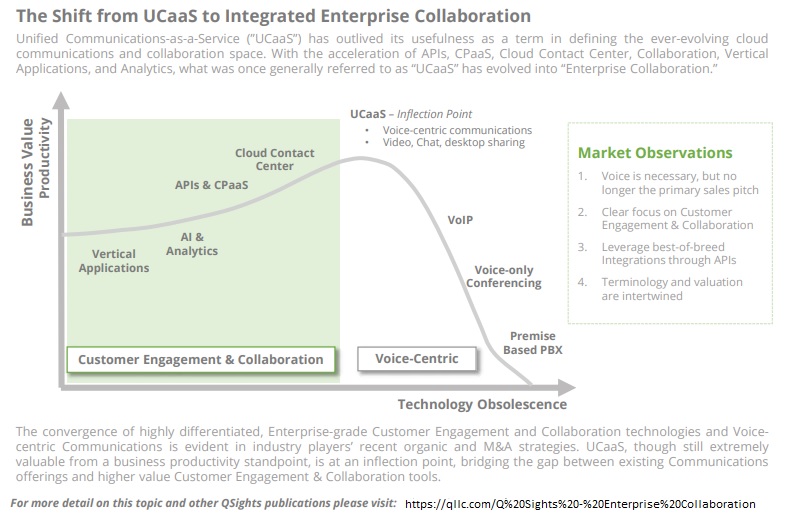
Meanwhile, Q Advisors is UCaaS has outlived its usefulness as a term in defining ever-evolving cloud comms and collab space. It is now Enterprise Coolab or Customer Engagement & Collab. Differentiation will come in the integrations, verticals and niches.

Didn’t know that Bandwidth.com has 50 million VoIP numbers in service for Google, Microsoft, Dialpad and surprisedly RingCentral!

T1 Slingers & Cloud

The sector of the channel affectionately known as the traditional telecom agent (or agents or sub-agents) sprang up in the heady days of long distance. Calling cards, which is still a thing by the way, led to long distance, where the agents would offer savings to switch carriers. That is literally the same deal as switching prepaid carriers on the 10-10 programs.

This was transactional. This was based on replacement sales and saving money. It was ink daily.

Along comes T1s and the LD Slingers had another product to sell – in the same manner. Replace that BellSouth T1 for a CLEC T1. Or even better replace those LEC POTS lines with a CLEC POTS line or the Integrated T1 – and save money.

Fast forward to 2018, zipping past the period when VoIP was sold as a POTS replacement to save money. We can see that broadband has replaced T1s; cable displaced DSL; DSL had previously displaced T1; Ethernet is available most places so we don’t even think about T3/DS3 anymore.

Now the sector is slinging SD-WAN to replace MPLS to save the customer money.

On a side note: this is why the industry is in a tail-spin: lowering bills means overall revenue declines. Certainly, a new CLEC is happy as they acquire LEC customers and move 80% of the LEC revenue billed to their coffers. However, they then had to pay the LEC for the underlying services. Then cable came along and ate everyone’s lunch.

Back to the T1 Slingers. They sling a different product now, but the sales process is the same. They still save the customer money. It is still transactional. And the agents in this sector are still doing it for a few reasons. One, they are motivated by ink. So happy to ink a deal a day – even a $200 cable deal. Ink, ink, ink! Happy, happy, happy.

Two, selling replacement services are a simple transaction without too many nuts and bolts. UCaaS and any cloud sale has too many moving parts. Back in the hey day of LD and Integrated T1, there was the porting headache but the carrier pretty much handled it. In a UCaaS deal, there isn’t an inter-connect to handle all the minutiae – and the provider isn’t either.

These are the two main reasons that the T1 Slingers in essence is still around and has not graduated to selling cloud – simplicity and motivation.

To move to a Solution Sale involves skills such as follow up and relationship building that are not present in a transactional sale. The sales cycle extends from a day or a week to months. You have to educate the customer and perform surveys (cloud readiness, PBX mapping, etc.) It gets complicated.

There is a final reason: the products just aren’t as stable as network. Period. There is certainty in network. Plug it in and it will work most of the time. But cloud sales involve a good amount of trust in the Ether. There are call quality issues with UCaaS; it is why SD-WAN is now pitched with UCaaS. This uncertainty is underlying. Mix that with the compensation – even 25% of a $300 bill isn’t enough for the headache.

To sum it up, the traditional agents (formerly T1 Slingers) have not migrated to selling cloud because, most importantly, they are motivated to get ink daily. Without motivation, not doing it. The other factors are simplicity, stability, ease and familiarity, plus a tiny dose of missing the skills of following up with extended sales cycles. These Agents are at the tail end of their career. They don’t want to change. And that is why they are still slinging network despite a thousand new vendors and hundreds of analyst pundits telling them to. They just aren’t motivated for it.