Peter Radizeski is Founder and President of RAD-INFO INC. He is an accomplished blogalyst, speaker, author and consultant. He has helped many service providers with sales training, marketing, channel development and business strategy. He is a trusted source of knowledge about the telecom sector. His honest and direct approach make him a refreshing speaker.

Look for his innovative ideas and analysis of current technology on his blogs.

Meet him at one of the many conferences he attends and speaks at.

Hire RAD-INFO today!

ICANN Loses US Control

“On October 1st. Nearly two decades after it created the Internet Corporation for Assigned Names and Numbers (ICANN), the body which oversees the internet’s address system, America’s government will let lapse a contract that gives it control over part of ICANN. This means that a crucial global resource will henceforth be managed by an organisation that is largely independent of national governments.” [economist]

ICANN was created back in 1998 as a global org that allowed everybody with an interest in the smooth running of the Internet, whether they are officials, engineers, domain-name holders or internet users, a voice.

According to Dan York from the Internet Society, it isn’t all that bad. “It is a good article, although I dislike the part at the beginning about “Whoever controls the Internet’s address book can also censor the Internet” because that is a HUGE over-simplification. ICANN is NOT able to delete an individual domain. All it could do would be to delete a top-level domain (TLD), which would make ALL DOMAINS under that TLD inaccessible. The ramifications of this would be enormous and the backlash within the ICANN community would be huge – so ICANN would never do it without lengthy public discussion before. (It has never been done by ICANN to date). So the article gives ICANN more power than it actually has. (Which is really very little.)

On September 30, 2016, organizations and individuals within the Internet’s technical community filed the attached amicus brief against 4 states suing to stop it. The IANA transfer status is here.

The Internet still works. On to the next fire.
____ Peter Radizeski is a telecommunications consultant and analyst with RAD-INFO INC. Service Providers have called on RAD-INFO INC for assistance improving sales, managing online marketing efforts, channel sales enablement and overall company strategy. Contact RAD-INFO INC at 813-963-5884 or https://rad-info.net

The Broadband Wars, Part 2

Something to think about in order to be different: Broadband Speed Tiers: Should You Eliminate Them as a Usage Based Billing Strategy? The suggestion is as follows: “Instead of emphasizing speed, why not emphasize a better broadband experience that delivers all the applications customers want, and base their monthly billing on their amount of broadband usage. It’s a bit of a paradigm shift that’s broader than just about shifting to a usage based billing strategy.”

On the other hand, C-Link presented data that showed Gigabit announcements helped to sell mid-level speed tiers.

BIG PROBLEM: 13% Only Use Smartphone for Broadband – and that number is growing!!! Pew Research via DSLR

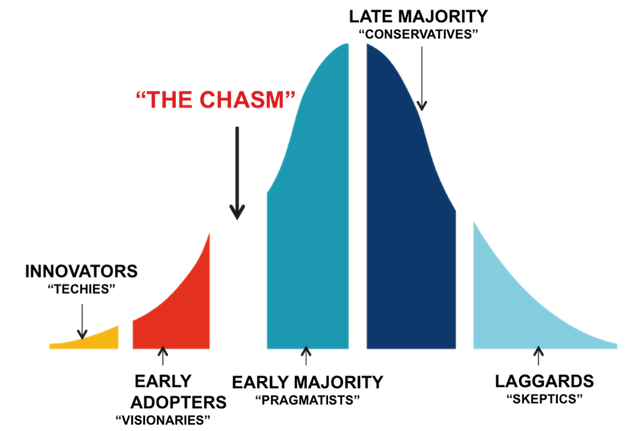
We have a chasm problem in both broadband in general (called the Digital Divide) and with FTTH specifically. It is hard to get past the early adopters (unless you have a monopoly), because people are used to DSL or Dial-up or using mobile data. Education and training are required to explain what can be done with Gigabit broadband beyond Netflix and other TV options. Tele-medicine, job opportunities, online learning, homework, side gigs (Etsy, eBay) and so much more.

Fixed Wireless is being used because Type II is expensive; and pole attachment is challenging. Fixed Wireless isn’t reliant on those issues.

____ Peter Radizeski is a telecommunications consultant and analyst with RAD-INFO INC. Service Providers have called on RAD-INFO INC for assistance improving sales, managing online marketing efforts, channel sales enablement and overall company strategy. Contact RAD-INFO INC at 813-963-5884 or https://rad-info.net

The Broadband Wars, Part 1

There are some interesting things happening in the residential broadband wars.

Powered by government money and mandate, the ILECs are upgrading broadband infrastructure across the nation. AT&T, Windstream, CenturyLink and others (notably NOT Frontier or Verizon) are using a variety of technologies to compete against DOCSIS 3.1, which has been kicking their ass for the last couple of years. G.Fast to the MDU; Fixed wireless using 4G/5G; fixed unlicensed wireless; FTTN (fiber to the neighborhood) then VDSL2 (e.g., the retired brand U-Verse) and FTTH.

These upgrades are proving profitable per WIND’s CFO: ARPU is up 5%.

Google Fiber acquired a WISP called Webpass. Following challenges with pole attachment rules and subsequent lawsuits in Nashville and Louisville from the Duopoly (AT&T and cable), Google Fiber is now looking at fixed wireless options to continue deploying Gigabit Broadband. Windstream, too.

“AT&T revealed today that it is trialing a 100 Mbps competitive fixed wireless broadband service to “multiple” apartment complexes in Minneapolis, a CenturyLink market,” reports Telecomp. And it is with fixed wireless (probably licensed)! “The AT&T broadband wireless offering initially will support speeds up to 100 Mbps per customer using millimeter wave spectrum in a point-to-point configuration.”

Windstream bought a WISP called BOB in 2013. Now they are pushing out fixed wireless in 40 markets. In NYC they use the 28 GHz band with a hub capacity can scale up to 13.2 Gbps.

Suddenlink (now owned by Altice which also owns Cablevision) is rolling out Gigabit, according to DSLR.

Want more info like this? Join the Facebook group.

What are Google’s ISP Plans? Not as big as you think.

ISPs Weigh in on FCC Privacy Proposal.

____ Peter Radizeski is a telecommunications consultant and analyst with RAD-INFO INC. Service Providers have called on RAD-INFO INC for assistance improving sales, managing online marketing efforts, channel sales enablement and overall company strategy. Contact RAD-INFO INC at 813-963-5884 or https://rad-info.net

The Sales Chasm

From Crossing the Chasm, this is the technology adoption model. Fiber to the Home aka Gigabit Broadband is a technology. Hosted PBX aka UCaaS is a technology. Your sales will follow this model. Getting the mainstream to BUY from you will be a challenge because you have to push through the chasm.

____ Peter Radizeski is a telecommunications consultant and analyst with RAD-INFO INC. Service Providers have called on RAD-INFO INC for assistance improving sales, managing online marketing efforts, channel sales enablement and overall company strategy. Contact RAD-INFO INC at 813-963-5884 or https://rad-info.net

Talent

A couple of resources on Talent. The first is 165 slides on Talent and How to Hire on slideshare.

The second is from Simon Sinek in a talk at Creative Mornings (podcast or video or article)

____ Peter Radizeski is a telecommunications consultant and analyst with RAD-INFO INC. Service Providers have called on RAD-INFO INC for assistance improving sales, managing online marketing efforts, channel sales enablement and overall company strategy. Contact RAD-INFO INC at 813-963-5884 or https://rad-info.net