Peter Radizeski is Founder and President of RAD-INFO INC. He is an accomplished blogalyst, speaker, author and consultant. He has helped many service providers with sales training, marketing, channel development and business strategy. He is a trusted source of knowledge about the telecom sector. His honest and direct approach make him a refreshing speaker.

Look for his innovative ideas and analysis of current technology on his blogs.

Meet him at one of the many conferences he attends and speaks at.

Hire RAD-INFO today!

Why Transactional Sales Folks Won’t Be Consultative

There are 3 types of salespeople in general: transactional, whale hunters and someone in-between.

Transactional salespeople won’t make good whale hunters and vice versa.

It has to do with motivation.

Transactional salespeople keep selling because they like the ink, the closing, the quick bang.

Whale hunters are not thrilled with a quick little kill. They like landing that big account. The thrill of the chase and all it entails. Whale hunters are good at managing relationships and a long sales process. Other types are not.

Sales is about self-motivation.

It is also about skill set. But more it is about which hunt you like.

That is why some partners will not become consultative salespeople. A long sales cycle that has to be managed is just unappealing, even if the reward (bigger commissions) is a nice carrot.

People do more to avoid pain than to chase pleasure.
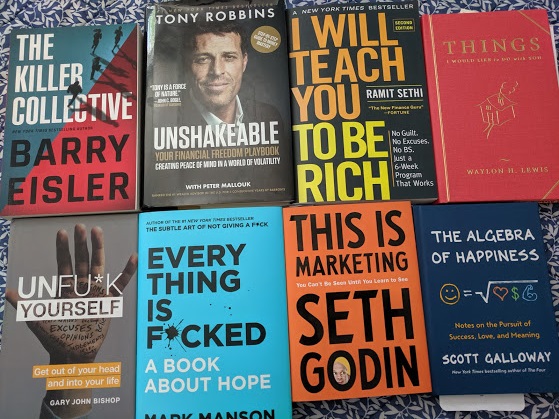
Books to Read in 2019

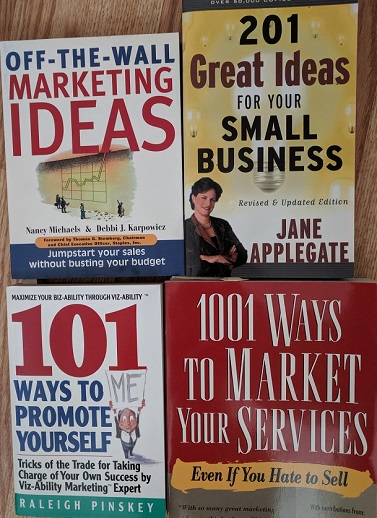
These are some old books but when you want to guerrilla market without a fancy budget, the ideas in these books are timeless.

Guerrilla Marketing by Jay Conrad Levinson
201 Great Ideas by Jane Applegate
101 Ways to Promote Yourself 
Off the Wall Marketing Ideas
Dan Kennedy is the Direct Marketing king (Robin Robins learned from him.) His best book is the NO BS Guide to Direct Marketing.
Seth Godin’s books are all gold in my opinion. His newest is This Is Marketing. This book is going on the trip. The others above are on my shelf since I used them before and saw that so many folks are struggling with FTTH marketing.

These are in the luggage. [What? It’s an 8 and one-half hour flight each way!]

The Algebra of  Happiness by NYU Professor Scott Galloway
Unshakeable: Your Financial Freedom Playbook by Tony Robbins
I Will Teach You to Be Rich by Ramit
Everything Is F*cked: A Book About Hope by Mark Manson

In case you didn’t read these in 2018 – go here for 4 more suggestions.

Or read any of my books HERE.

The Industry is Unstable

A certain VP at a currently bankrupt provider asked me if the industry isn’t better with a strong CLEC. I said of course the industry is better with a strong CLEC. CLECs have been the cornerstone of the channel for many years.

However, there are few large and stable CLECs left in the game. And his company was not stable.

Would a channel partner sell an unstable company’s services? No business buyer likes uncertain.

No channel partner wants to deal with uncertainty either. Our commissions are the lifeblood of our businesses. Look how well evergreen clauses in contracts work when the carrier goes BK.

Granite and Bullseye are probably the larger CLECs left that are solid.

GTT is like Birch or Fusion – a sloppy mix of merged providers.

The CEOs of Birch, GTT and Fusion must have gone to the same school as Ruberg. He was CEO of Tampa’s Intermedia Communications, the first billion dollar CLEC. It sold to MCI for pennies on the dollar when the debt came due.

Zayo has been a handful to work with. They were just taken private by private equity. The statement said management as staying in place, but no one knows if they will get any friendlier to the channel – or fix their issues.

There are a handful of smaller resellers who are channel friendly, like TPX, NITEL, Ntegrated, APXnet and AireSpring.

Otherwise it is ILEC or Cable – the 4 Horsemen: Verizon, AT&T, Comcast and Charter.

Altice USA is there but I have no idea how channel friendly. Cox is tough on the channel (referral program).

Sprint – in the middle of being acquired.

Frontier is uncertain due to too much debt combined with service issues. Talk of bankruptcy here too.

CenturyLink is still trying to figure out the Level3 acquisition. There are stories about spinning off the ILEC consumer and SMB business. Revenues are trending downward as the ILEC operations are rural and losing ground to cable competition. Hence, the spin off talk. Yet internally, it is a question of which legacy business do you want to do business with – and who has login privileges? US West, Qwest, Embarq, CenturyTel, Level3, TWT?

There are thousands of cloud providers that channel partners can sell for SaaS, IaaS, UCaaS, Cloud Contact Center, VPS and so much more. But it all rides on network. It all requires an ISP. And if you sell WAN, you want it to be reliable and quality.

Cogent, FiberLight, Crown Castle, Masergy, NTT, WOW! are contenders.

Who are you selling?


Residential Fiber Marketing: Do You Need TV?

The best data I have seen on broadband and TV has come from Cable One (top 10 MSOs), since the CEO there declared 3 years ago that it was going to de-emphasize TV and focus on broadband.

When Cable One acquired NewWave cable in 2016, they released this data. 428k homes passed, 23.5% video penetration, 25.8% broadband penetration. Overall Cable One has a 31% broadband penetration of homes passed.

Light Reading reports, “Cable One’s strategy to focus on broadband and de-emphasize pay-TV continued to play out in Q1 2019, as the operator saw its average revenue per unit (ARPU) reach an industry high among its US peers. … A residential broadband ARPU of $70.80 in Q1 made Cable One the first publicly traded US cable operator to eclipse the $70 mark, according to Craig Moffett, an analyst with MoffettNathanson.”

Cable One’s average data usage at the end of Q1 was 290 gigabytes per month.

4 Reasons TV is Changing & Declining:

  1. The term cable is becoming extinct [HERE]
  2. Comcast and Cox have added Amazon Prime and Netflix as a channel.
  3. Hotels now have channels on the TV to login to Netflix, Amazon and Hulu to reduce the TV costs for the company.
  4. “The firm said that about 31 million U.S. consumers, 12% of the adult population are Cord Nevers (CNs).” [source]

It isn’t about the triple play as much as it is giving your customers options and value — and explaining that value.  Choice & Value.

Gigabit penetration nationwide is just 6%, but it gets them to buy higher speeds.

  • Do you customers have a computer? Tablets? Alexa? Hardware-as-a-service, folks!
  • Do you rent Apple TVs or Roku?
  • If you sell fixed wireless, do you offer HDTV antennas?
  • If you sell voice, do you block Robocalls?

WI-FI

Business or home wi-fi is very important. Comcast knows it.

U.S. broadband households now have an average of 9.1 connected devices,” said Brad Russell, Research Director, Connected Home, Parks Associates.

BRANDING!

Charter re-branded as Spectrum. Cable One is re-branding as Sparklight. Verizon has FiOS.

  • Do you have a product brand?
  • Did you have a service launch plan for your fiber?
  • Are you using CRM?
  • What tactics are you using to reach customers? List them.
  • How are you tracking each campaign/tactic?

Pew Research data on household demographics – Home broadband use by income [here]

About 65% or more than 164 million adults in the United States play video games, according to a new video game demographics report from the Entertainment Software Association (ESA). [source]

TELEHEALTH:”Nearly a quarter (22%) of physicians have used telehealth to see patients, and a new telehealth forecast suggests that 61% of doctors will use it by 2022.” [source]

Microsoft’s Airband Program is looking for partners. AT&T’s FirstNet wants more rural partners.

The Differences in Channel Programs are Huge

Many channel heads want a channel like Microsoft or Cisco in the 90s and 2000’s. Yet I am uncertain if they understand the nuances of the Cisco & Microsoft channel programs and why they were more effective than most telecom and cloud channel programs.

It is easy to examine the legacy hardware channels like Dell, HP, Xerox and Cisco. The business model was designed around the vendor. The partners business was heavily invested in the vendor. The VAR was certified, took continuing training, went to product launches. The result was a discount off of MSRP and better support.

You worked to keep your Gold status in order to get better, faster support for your customers. Training kept you current and relevant.

Microsoft’s programs were similar. User groups all over the world to get people networked, educated, sharing, advancing. VARs were invested. They were aligned. Plus 90+% of computers were running some version of Microsoft O/S and other software.

Now think about this: a Microsoft exec said that every goof they make creates opportunity for support from partners.

These programs spawned a multi-million dollar training industry. Even community colleges got involved in the 1990s. I took my Cisco and MS classes at HCC in Tampa.

Once you were certified, you were a Brand Ambassador.

Is a Cisco CCDA going to deploy Cisco or Juniper or ADTRAN?

And 2 final elements of these programs: BRAND & DEMAND!

These tech companies developed a brand that helped create demand from consumers and businesses that the partners then fulfilled.

The best tech doesn’t win (or we would all have Ubuntu laptops!). The best Marketing wins!

Now look at YOUR channel program.

How many elements are missing?

  • Aligned Partners
  • Business Model Built Around Your Company
  • Certification Program
  • Better Support for Aligned Partners
  • Better Margin for Platinum than Silver Partners
  • Brand
  • Demand

Channel Sales Enablement is about helping to make your channel sales program more effective. You need Aligned Partners. Want help call the RAD-INFO office at 813-963-5884  We have done this for a number of channel programs; we can do it for yours.