Peter Radizeski is Founder and President of RAD-INFO INC. He is an accomplished blogalyst, speaker, author and consultant. He has helped many service providers with sales training, marketing, channel development and business strategy. He is a trusted source of knowledge about the telecom sector. His honest and direct approach make him a refreshing speaker.

Look for his innovative ideas and analysis of current technology on his blogs.

Meet him at one of the many conferences he attends and speaks at.

Hire RAD-INFO today!

UC Quarterly Earnings

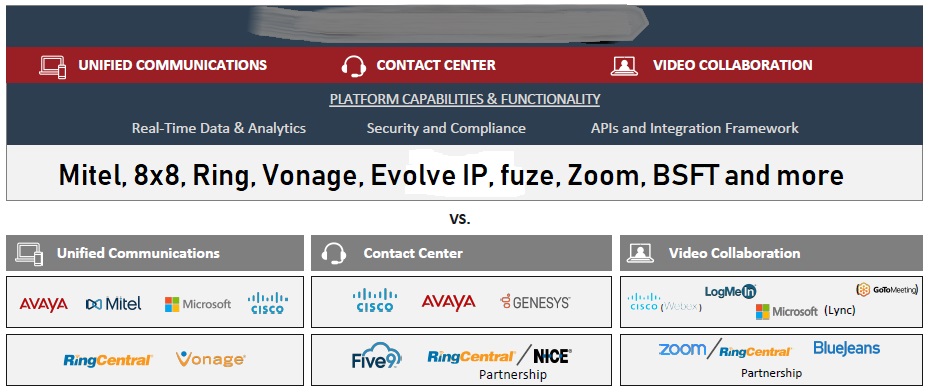
I have a hard time telling the Big 3 apart. RingCentral, Vonage and 8×8. They make the same noise, about the same things and all have very similar functions – PBX/UC+ContactCenter+Video+CRM. All 3 are pushing a single software platform.

Here are some thoughts on the Big UC 3 and their reports.
In a RingCentral investor deck, RC says that for knowledge workers, voice is only 44% of how the communicate with team messaging and texting about 30% each and video about 11%. Email not on that graph. I guess Slack is under team messaging.  Please note that it says for Knowledge Workers. There are about 130M full time employees in the US. Somewhere between 40-45% are knowledge workers (55-60M).

If you consider that most workers are in fact NOT knowledge workers, then the true UC market is just 60M in the US. The other 70M need dial-tone and location based phone.

8×8 puts out the best stats in their reports.  The key point I saw for 8×8 was: “Bundled UCaaS & CCaaS Continues to Resonate: 52% of new MRR from mid-market/enterprise were combination deals.”

  • Total ARPU is $516 at 8×8. It is $408 at VON. Ring did not report.
  • Mid-market ARPU is $5364 for 8×8
  • 8×8 has no debt. VON has $559M and RNG has $410M.
  • 1M+ global seats by 8×8. No one else reported seat/user numbers.

Total quarterly revenue for:

  • Ring has $201M, 34% growth YoY.
  • Vonage is $280M; Vonage Business is $180M, 31% growth YoY.
  • 8×8 is $93.8M,  18%. 2019 full year is $334.4M

They all seem to focus on midmarket/enterprise. [Not certain they all define mid-market the same.] Likely that is because it is what investors want to see or it is the only way to keep the machine churning. Although if they could be efficient on deals under 100 seats they could win all day. Yet 64% of the revenue from 8×8 is in small business. [8×8 defines small business as customers with revenue <$50m.]

In Ring’s last investor deck, Overall Office churn is 10%! Channel driven sales have half that churn. Channel driven sales have more revenue. The deck is a lot projections and fluff. They talk about innovation but it’s all M&A.

To show the disruption that 8×8 (being the oldest) is causing:
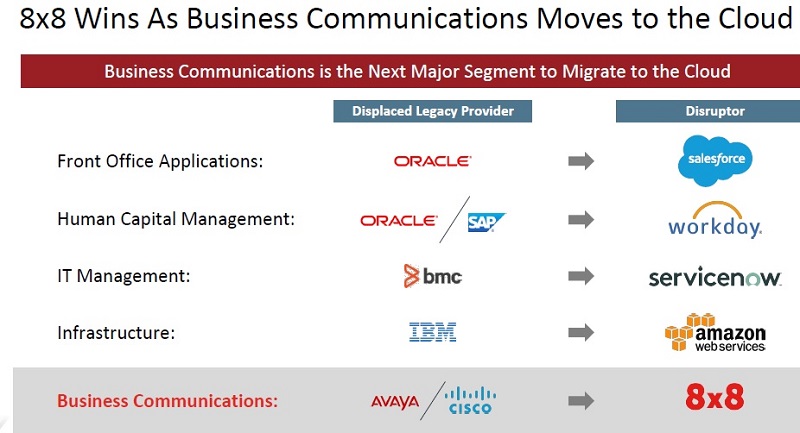
The funny thing is that AWS & Azure have beat up IBM Cloud (and Google Cloud), but 2000 providers have had a chance to disrupt the premise PBX in the last 15 years with little luck. It took Salesforce, who started in 1999 as an ASP, just 10 years to hit $1B in revenue. Ring started in 1999; VON in 2001; 8×8 in 1987; and Zoom in 2011. None have hit $1B in revenue.


BTW, Zoom went public.

  • It posted $330 million in revenue in the year ending January 31, 2019 with a gross profit of $269.5 million
  • It more than doubled revenues from 2017 to 2018, ending 2017 with $60.8 million in revenue and 2018 with $151.5 million.

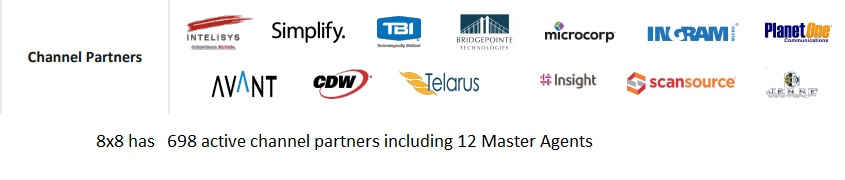
 

At least these numbers look reasonable from a partner perspective, unlike the partner stats that RING used.


What is Cisco doing with Broadsoft? As I mentioned in my weekly newsletter, the rumor out of Cisco is that no more development on Broadsoft softswitch and Broadworks. Going forward it is what it is. Cisco is using it to power their key cloud service: Webex Teams. (At least this year it is the showcase service like Spark was before it.) Cisco likes to end of life things like Team One.


M&A

Mitel-Avaya merger opinion is here.

The Mitel-Avaya Merger Mania

This rumor still persists: that Mitel and Avaya will merge and create a company that will rival Cisco and Microsoft in the UC space.

Wall Street likes the idea of a Mitel-Avaya merger because they always like a merger. The bankers make bug commissions. Execs get bonuses. However, People get laid off.  Synergies never happen. Integration is a disaster. And you end up with 1+1= 1.2

Mitel is already a mash-up of hardware and cloud with Mitel and Shoretel premise gear mixed with Mitel and Shoretel cloud UC services. This merger happened in September of 2017. Then 7 months later Searchlight Capital (which owns Rackspace) acquired Mitel. It must not be looking good from the inside to be considering a merger already.

Or it is very difficult to shift culture from a premise based company to a cloud services model. Make Bell-heads think like Net-Heads. Yeah, that is almost impossible.

Avaya just came out of BK (bankruptcy) at the end of 2017. They haven’t fixed anything. And certainly their user base is not certain how stable they are. A merger is just the latest move by the stakeholders to get out alive.

This merger doesn’t help anyone but financial stakeholders.

Partners, customers, employees all get shafted here.

The cultures don’t mesh for one thing. Shoretel and Mitel still are suffering from their own culture war.

It takes a lot to migrate to a cloud services company. Ask Cbeyond, Birch, TPX, Avaya, Mitel, Shoretel, Cisco, Dell, HPE. It takes a LONG time. It takes a culture change. It takes an employee shift and replacement. It takes marketing, strategy and execution.

None of that looks appealing and neither does this merger.

Either company may make the switch to cloud alone but neither will able to do that while undergoing a merger.

As Shai points out HERE, both companies have so many platforms and SKUs that it would be a huge mess.

Automation to the Channel

As I have written before, Partner Marketing for the most part is awful or at the very least ineffective.

We live in a time for personalization or at the least list segmentation. We have online polls, access to Big Data and other tools to get better at marketing. However, nothing beats a conversation.

Three simple questions can help out any channel program:

  1. What are you interested in hearing about?
  2. What is the your primary business focus?
  3. How do you see our company fitting into your portfolio?

In 20 years as an agent, I have had that conversation at most 3 times.

The problem lies in the underlying channel strategy: it is all about mass market. Let me break you of that notion. There is already an AT&T and a Verizon. You ain’t it. Figure out where you add value in the marketplace and explain that. Clearly.

Here are some stats for you:  Cbeyond was one of the more successful CLECs. They only had 81K accounts. USLEC had 26K.  Fusion (Birch) after 27 acquisitions has a grand total of 150,000 business customers.

Mass is not happening. Although 150K is a pretty large business.

The issue is the KPIs (key performance indicators). What KPIs are you looking at?

Is it the number of quotes? Sales/revenue numbers? Number of agent agreements inked?

Since the close ratio is less than 10% in most cases, the number of quotes is a nice number but shadows the fact that you are quoting haphazard. Fix the way you quote and what you quote, get less quotes in the funnel but the close ratio goes up.

I often hear that if a channel manager can talk to the end user, they can close 80%. Is that a KPI you track? Not yet I would imagine.

Sales numbers is a lazy KPI. Period. Daily sales activity results in sales. Track the activity.

Number of agents? This is a joke. Remember the Fog the Mirror jokes. We are back to that. I see press releases all the time with a ridiculous number of partners listed. Like this one:

It isn’t the number who sign; it is the number who ALIGN!
As more automation happens, open rates will decrease, partners will start using random emails to register for events and such. It comes down to partners didn’t give you permission (see spam or Seth’s book) for their attention. And likely they don’t trust you. But you need BOTH of those components – Trust and Attention – in order to have an aligned partner selling your stuff.
And that comes down to relationship. You can’t automate that. You will try. You will waste time and money – and you will fail.
You have to build a Brand that attracts partners.  Sorry but that’s what winners do: Cisco, Datto, Microsoft, Dell.
Here’s another point about automation:
It is easier to automate things you can sell on Amazon. Ingram and Tech Data have had portals with online catalogs and real time inventory for 20 years. Product specs and details about stuff that is a commodity. This worked for POTS lines, PRIs, T1s, broadband and cell service, because those are mass market. Buyers understand them. They are essentially the same despite the provider.
Everything else you are selling – UC, SD-WAN, security, cloud services – is complex. It isn’t the same no matter who provides it. In fact, no two BSFT or Velocloud partners deploy It requires technical knowledge, consultative selling, complicated deployment and more. How do you automate that?
Heck, most employees of service providers can’t tell you what the company offers or what the value proposition is. Work on fixing THAT communication problem before you start automating the channel.

Rural Broadband News Links

It’s Microsoft vs. Comcast in infrastructure push to expand rural broadband – but a big mapping problem. Microsoft is still pushing its White Spaces Plan at the FCC.

On the map: Microsoft has its own map that it uses for Airband Project.

There are many parties involved in broadband mapping including the FCC, the NTIA (part of the Dept of Commerce) and the USDA. There are many lobbying bodies sticking their nose in, most notably NTCA. The others include Connected Nation, WIA – The Wireless Infrastructure Association, ITTA – The Voice of America’s Broadband Providers and CCIA.

It looks like only about 2% of the households are without broadband. [FYI, In 2018, there were about 127.59 million households in the United States.] “The last two percent of U.S. housing locations, as shown by the U.S. Federal Communications Commission National Broadband Plan and Broadband Availability Gap analysis, are the areas where the geographically-produced digital divide is most acute,” as reported by Gary Kim. BUt then it depends which map/data is used, right?

The FCC has yet another program to give USF moneys to rate-of-return carriers:

“The FCC said today that it has made new offers of broadband support to 516 rural carriers. The new FCC broadband support offers target more than one million homes and businesses and are based on the ACAM (alternative Connect America) cost model. The offers went to rate-of-return carriers that previously rejected or weren’t eligible for ACAM broadband support. … If a carrier accepts a new offer, it will receive funding over a period of 10 years and will be required to meet specific build-out milestones over that time.” [telecomp]

Fun Fact:
Charter: Broadband-Only Users Average 400 GB of Monthly Data Usage
Comcast said median usage is around 200 gigabytes

Soaring Stock and Valuations

Maybe every tech company should go through the pitch process. In that process, founders learn a lot about their story, idea, pitch and value – as seen through the eyes of a bunch of investors. (Take that for what it is worth.)

Today’s headline – RingCentral’s 615% Share Price Increase Shows How Capitalism Can Build Wealth – and the latest IPO Valuations of Lyft, Uber, Pinterest and Slack demonstrate that IT IS ALL ABOUT MARKETING!


RingCentral has made good moves and their technology may or may not be better than the other 2000 providers in the UC space, but it is their marketing that has gotten them where they are. They are not profitable. They have the same features and functions as many others, but they have outspent their competitors in sales and marketing.

“Because RingCentral is loss-making, we think the market is probably more focused on revenue and revenue growth, at least for now. Generally speaking, companies without profits are expected to grow revenue every year, and at a good clip. That’s because it’s hard to be confident a company will be sustainable if revenue growth is negligible, and it never makes a profit.” [source]

How do you sustain growth? By spending on Marketing. The emphasis is on Marketing & Sales.

Uber was NOT the first car-sharing company. In fact, there were 20+ others before Uber came along. Why is Uber bigger? PR and money. Even bad PR worked in their favor for branding. Lyft raised a total of $4.9 billion in capital in 18 rounds, according to CrunchBase, while Uber has raised $24.7B in 23 rounds!

Pitching is about story telling. Marketing is about story telling.

If you look at your growth and it isn’t where you want it to be, examine your sales and marketing budget – and efforts. Then review the story you tell. (Then call RAD-INFO Inc to fix it at 813-963-5884)

For the most part tech marketing looks like this from GapingVoid:

basically ignored because we think the tech is everything.. and it isn’t. The best tech doesn’t win. The best marketing wins.